
Buying & Selling | Massachusetts Real Estate
Massachusetts Smoke & Carbon Monoxide Certificate
What Buyers and Sellers Should Know Before Closing
Buying & Selling | Massachusetts Real Estate
What Buyers and Sellers Should Know Before Closing
When a residential property is sold or transferred in Massachusetts, the applicable smoke and carbon monoxide alarm requirements must be addressed before closing. The local fire department performs the compliance inspection and, when the property passes, issues a Certificate of Compliance. The exact requirements can depend on the property’s age, renovation history, heating equipment, garage configuration, and applicable building and fire codes.
For buyers and sellers, this is one of those relatively small closing items that is much easier to handle early than at the last minute.
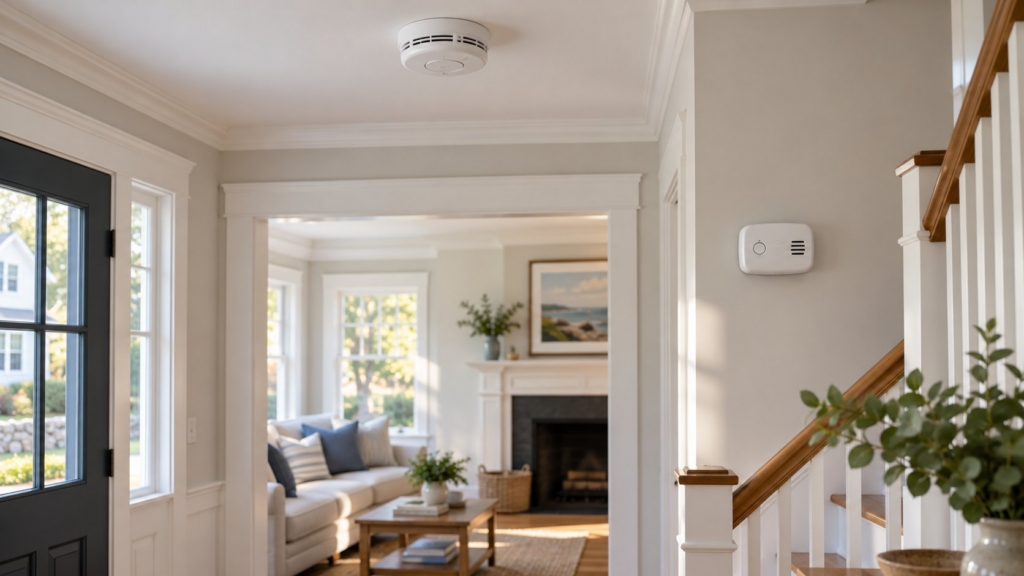

The Certificate of Compliance is issued by the local fire department after an inspection confirms that the property meets the applicable smoke and carbon monoxide alarm requirements.
Massachusetts uses the standard FP-007C Certificate of Compliance form for inspections under Chapter 148, Sections 26F and 26F½. The state form specifically covers both smoke detectors and carbon monoxide alarms.
The certificate is commonly part of the documents needed as a Massachusetts residential transaction approaches closing. It is one of the documents typically gathered for closing.
In a typical Massachusetts sale, this is a seller-side responsibility.
Massachusetts law (M.G.L. c. 148, §26F) states that, upon sale or transfer, a home must be equipped by the seller with approved smoke detectors, and the Certificate of Compliance is how that is documented for closing.
In practice, a seller’s Realtor may help coordinate or track the fire department inspection, but the compliance obligation remains associated with the property owner and transaction. Sellers should plan to schedule the fire department inspection before closing.
The inspection is performed by the local fire department or fire district serving the property.
If the alarms satisfy the applicable requirements, the department issues the Certificate of Compliance. If the property does not pass, the seller must correct the issues and arrange another inspection before closing.
For Cape Cod properties, sellers should contact the fire department or fire district that serves the specific town or property.
The Massachusetts Department of Fire Services advises homeowners to contact the local fire department as soon as they have a closing date.
Scheduling early gives the seller time to identify expired alarms, replace noncompliant devices, correct placement issues, clarify building-permit history, and schedule a reinspection if necessary.
Massachusetts instructs sellers to determine when the home was built and when the most recent building permit was issued for renovations, additions, or modifications. Those dates help determine which smoke and CO alarm standards apply to the property.
Homes built or substantially altered after January 1, 1975 may be subject to the building-code requirements in effect when the relevant permit was issued. Older one- and two-family homes have specific fire-code requirements.
That means sellers should not copy the alarm setup from another house or assume that a device is compliant simply because it works.
Every home should have working smoke alarms, but the exact configuration required for a sale depends on the property.
For typical one- and two-family residences built before January 1, 1975 that have not been substantially altered, Massachusetts guidance requires smoke alarms in locations that include:
Replacement alarms in these older homes have additional requirements, including approved photoelectric technology and, for new battery-powered alarms, a sealed 10-year battery.
However, newer homes or homes with qualifying renovations may have different hardwiring, interconnection, or placement requirements under the building code. The safest approach is to use the Massachusetts guide for the property’s construction and permit date and confirm any uncertainty with the local fire department.
Massachusetts law requires CO alarms in residential properties that contain fossil-fuel-burning equipment or include enclosed parking within the structure. Examples of fossil-fuel-burning equipment may include:
For properties covered by the law, the residence must be inspected for CO-alarm compliance upon sale or transfer.
Massachusetts guidance generally requires CO alarms on every level of the residence, including habitable portions of basements and attics. On a level containing sleeping areas, a CO alarm should generally be located within 10 feet of bedroom doors.
Approved CO devices may include battery-operated, plug-in with battery backup, low-voltage, wireless, or qualifying combination alarms, depending on the applicable requirements.
Alarm age matters.
Massachusetts instructs sellers to check the manufacturing date printed on the alarm. If there is no date, the state says the alarm has expired and must be replaced.
Smoke alarms generally have a service life of about 10 years, and older alarms should be replaced in accordance with the applicable requirements and manufacturer instructions.
CO alarms often need replacement sooner. Massachusetts guidance says many CO alarms last approximately five to seven years, although newer units may have a 10-year sealed battery and are replaced as a complete unit at the end of that period.
Before the fire department arrives, sellers should:
Massachusetts also cautions consumers to purchase alarms listed by a nationally recognized testing laboratory, such as UL or ETL, and to avoid counterfeit or unlisted devices.
The certificate is issued only after the property meets the applicable requirements.
If the fire department identifies a problem, the seller will need to correct the issue and arrange for the property to be reinspected before the certificate can be issued. Common issues can involve:
This is another reason not to schedule the inspection at the last minute.
Fees are controlled by Massachusetts law, although the actual local charge may be lower. For an inspection conducted separately, the statutory maximum is:
If the smoke-alarm and carbon-monoxide inspections are performed at the same time, the owner cannot be charged an additional fee for the CO inspection. Sellers should still contact the local fire department for its current scheduling procedure and fee.
A buyer’s general home inspection and the fire department’s smoke/CO compliance inspection serve very different purposes.
The home inspection evaluates the property’s systems and condition for the buyer. The fire department inspection is specifically intended to determine compliance with Massachusetts smoke and, when applicable, carbon monoxide alarm requirements associated with the sale or transfer. One does not replace the other.
Buyers generally are not responsible for obtaining the seller’s certificate, but they should still confirm that it is being tracked before closing.
Your Realtor and closing attorney can help verify that the appropriate closing documentation is in place.
Buyers should also understand that a passing smoke/CO inspection is not an evaluation of the entire property. It does not replace a home inspection, title review, septic inspection where applicable, or other transaction-specific due diligence.
Requirements can be more property-specific for condominiums and multifamily buildings because the building may have shared alarm systems, common areas, or fire-protection requirements that differ from a typical detached one- or two-family home. Massachusetts smoke-alarm statutes also distinguish among different building types and fire-protection systems.
For a condo or multifamily sale, the safest approach is to contact the local fire department and, when appropriate, the condominium association or property manager to determine exactly what inspection and documentation are required for that unit and building.
60 days from the date it is issued.
The local fire department issues the Certificate of Compliance after the property passes inspection.
It is generally a seller responsibility.
No. Massachusetts recommends contacting the local fire department once the closing date is known.
Most do, but under Massachusetts law the requirement specifically applies to residences containing fossil-fuel-burning equipment or enclosed parking, along with any stricter building-code requirements that may apply.
Yes. When the two inspections are performed simultaneously, Massachusetts law provides that there is no additional fee for the CO inspection.
Not necessarily. The inspector also considers factors such as alarm type, location, age, power source, and the requirements applicable to that particular property.
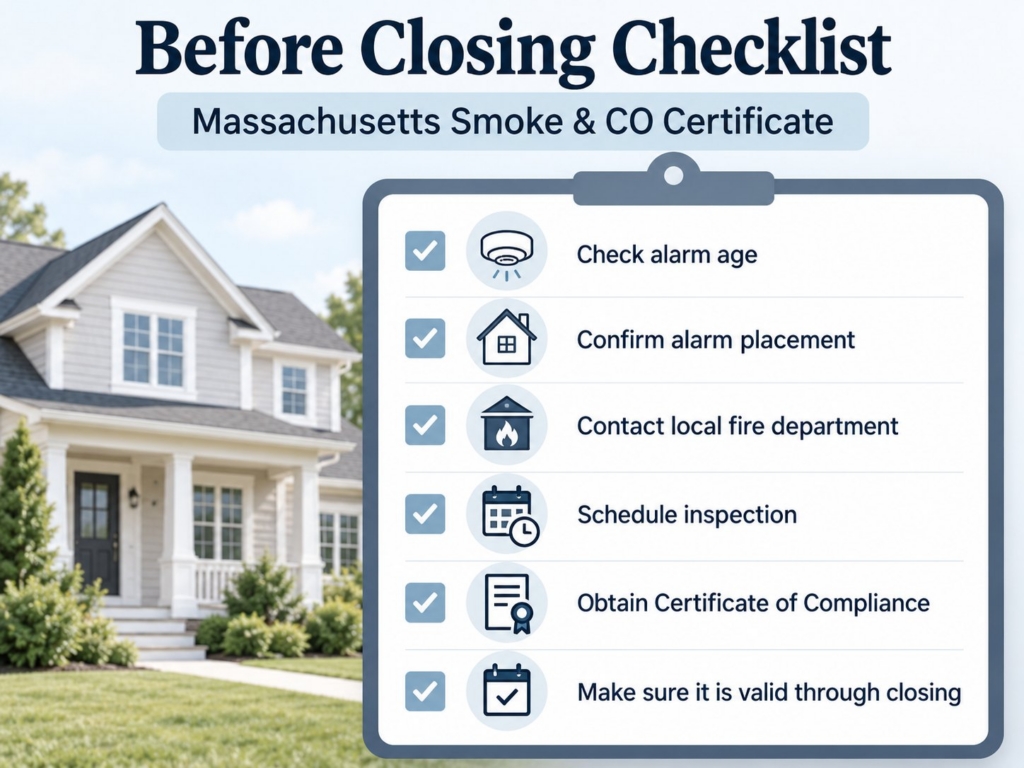
Massachusetts smoke and carbon monoxide compliance is a routine part of many residential closings, but the details are property-specific. For sellers, the best process is:
For buyers, make sure the certificate is being tracked with the other required closing documents. Handling this early can prevent a relatively straightforward compliance item from creating an unnecessary last-minute issue.

Real estate transactions involve many moving parts between an accepted offer and closing. Nancy Cassano can help you understand the process and stay organized as you prepare for your next move.
Nancy Cassano | Realtor | Serving Greater Boston & Cape Cod
Phone: 508.954.3420
Email: nancyc@todayrealestate.com

This article is based primarily on guidance from the Massachusetts Department of Fire Services and Massachusetts General Laws Chapter 148. Exact requirements may vary based on the property’s construction date, renovation history, equipment, building type, and local circumstances. Property owners should confirm the current requirements and appointment procedures directly with the local fire department.
Compare listings
ComparePlease enter your username or email address. You will receive a link to create a new password via email.